

 Español
 عربى
عربىIndustrial post bed sewing machine selection is often discussed after a production line begins handling three-dimensional products rather than flat materials. During trial sewing, operators usually discover that the challenge is not stitch quality itself but whether the needle can comfortably reach the sewing position without repeatedly folding or forcing the workpiece.
For sourcing teams, the conversation around an industrial sewing equipment upgrade frequently starts after several production orders expose the same bottleneck. Products are completed, but operators spend too much time repositioning them before every seam.
Flat Sewing Tables Do Not Suit Every Product
A production line making wallets, boots, handbags, or automotive trim does not always struggle because of fabric thickness.
Instead, operators often pause because the workpiece cannot move naturally around the needle.
Corners become difficult.
Curved edges require extra handling.
Hands repeatedly change position.
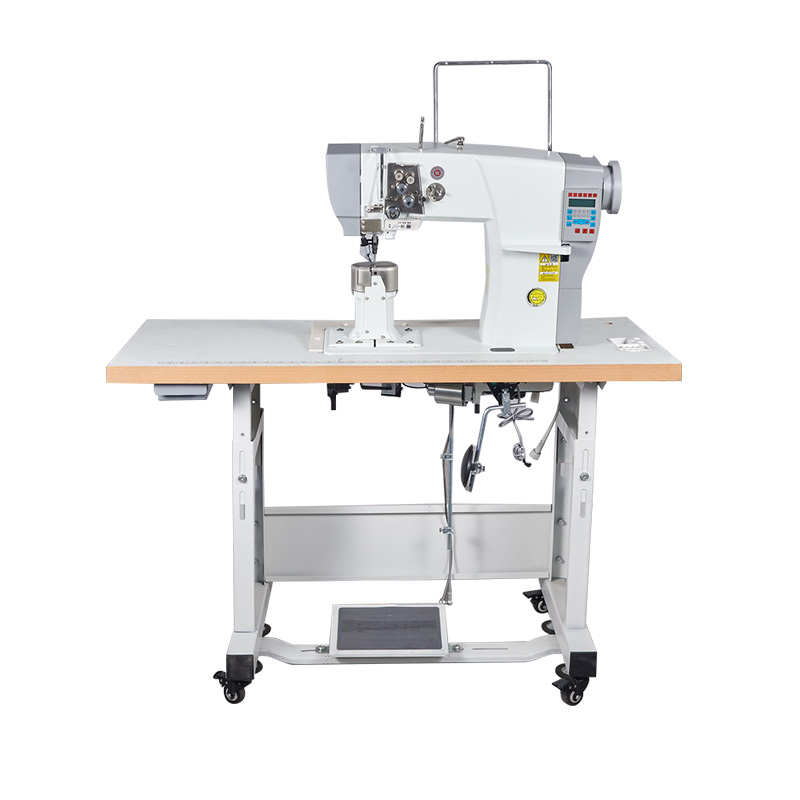
These interruptions are usually noticed long before anyone suggests replacing the machine. When an industrial post bed sewing machine is introduced for testing, engineers often compare operator movement as carefully as stitch appearance.
Operators Watch The Working Space
During sample production, technicians rarely look only at the finished seam.
They observe how easily the material travels around the sewing area.
A taller working column leaves more open space beneath the product.
That extra clearance allows larger pieces to rotate without constantly touching the machine body.
Production notes often mention these handling differences while evaluating an industrial post bed sewing machine for future projects.
Sewing Rhythm Changes With Product Shape
Factories producing flat textile panels usually maintain a steady sewing rhythm.
Three-dimensional products behave differently.
An operator may stop briefly before every corner.
Rotate the product.
Adjust the grip.
Continue sewing.
Those repeated interruptions affect hourly output more than stitch speed itself.
When testing an industrial post bed sewing machine, supervisors often record how many repositioning movements disappear during one production cycle.
Visibility Matters During Curved Seams
Needle access is only part of the process.
Line of sight also changes.
When bulky products surround the sewing area, operators sometimes lose a clear view of the stitching path.
A raised sewing position improves visibility for many curved applications.
Rather than measuring this with instruments, workshop teams usually compare operator feedback after several hours of continuous work with an industrial sewing equipment trial.
Different Products Create Different Handling Patterns
|
Product Type |
Common Handling Challenge |
Observation During Trial |
|
Leather bags |
Narrow openings |
Easier rotation around the sewing point |
|
Footwear uppers |
Curved stitching path |
Less hand repositioning |
|
Automotive trim |
Large formed panels |
Better access near raised edges |
|
Protective covers |
Box-shaped construction |
Smoother movement around corners |
Instead of focusing on sewing speed alone, engineers often evaluate whether an industrial post bed sewing machine reduces unnecessary handling throughout these operations.
Production Records Often Mention Small Delays
Machine reports usually contain numbers.
Workshop notebooks contain observations.
"Stopped twice at the corner."
"Operator changed grip repeatedly."
"Material touched the table edge."
These short comments frequently reveal more about production efficiency than cycle statistics alone. During equipment evaluation, they become useful references when comparing different industrial sewing equipment options.
Material Thickness Is Not Always The Main Issue
Heavy materials certainly influence sewing.
However, product geometry often creates the larger obstacle.
Even relatively thin leather parts may become difficult to control once they are assembled into three-dimensional shapes.
Engineers watching a trial with an industrial post bed sewing machine often pay closer attention to product movement than to penetration force.
Continuous Orders Reveal Long-Term Differences
A short sample run may not expose every advantage.
After several production shifts, repetitive movements become easier to identify.
Less twisting.
Fewer pauses.
More consistent feeding through complex sections.
These observations usually appear gradually while an industrial post bed sewing machine remains in daily operation on the production floor.
Purchasing Discussions Usually Begin After Production Feedback
Equipment selection rarely starts in the purchasing office.
It often starts beside the sewing line.
Operators describe where products become difficult to control.
Supervisors compare production records.
Maintenance staff review machine utilization.
Only after these conversations does the purchasing team begin evaluating another industrial sewing equipment solution for future manufacturing orders.
