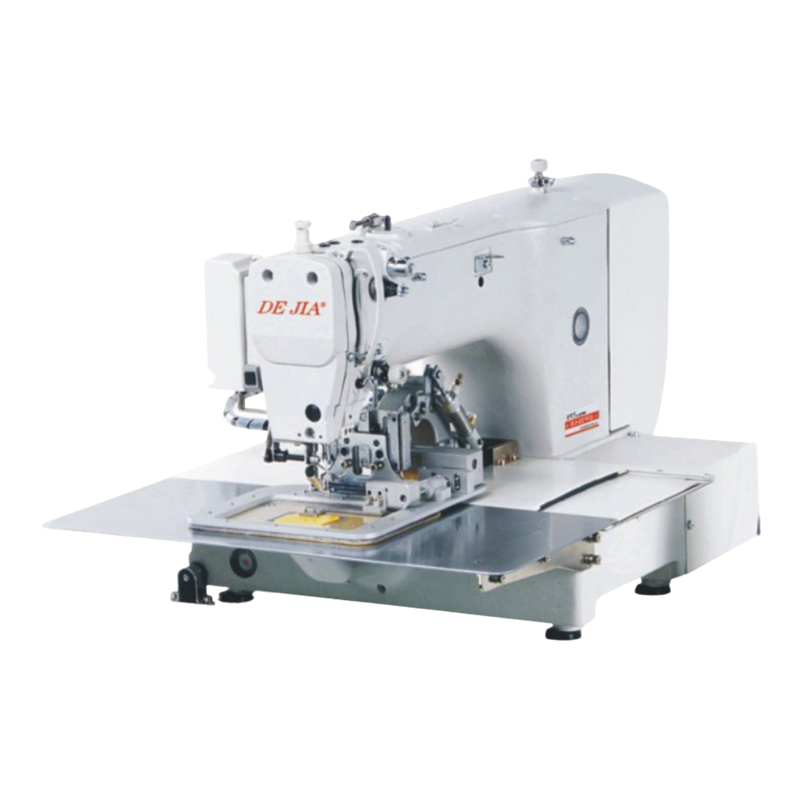
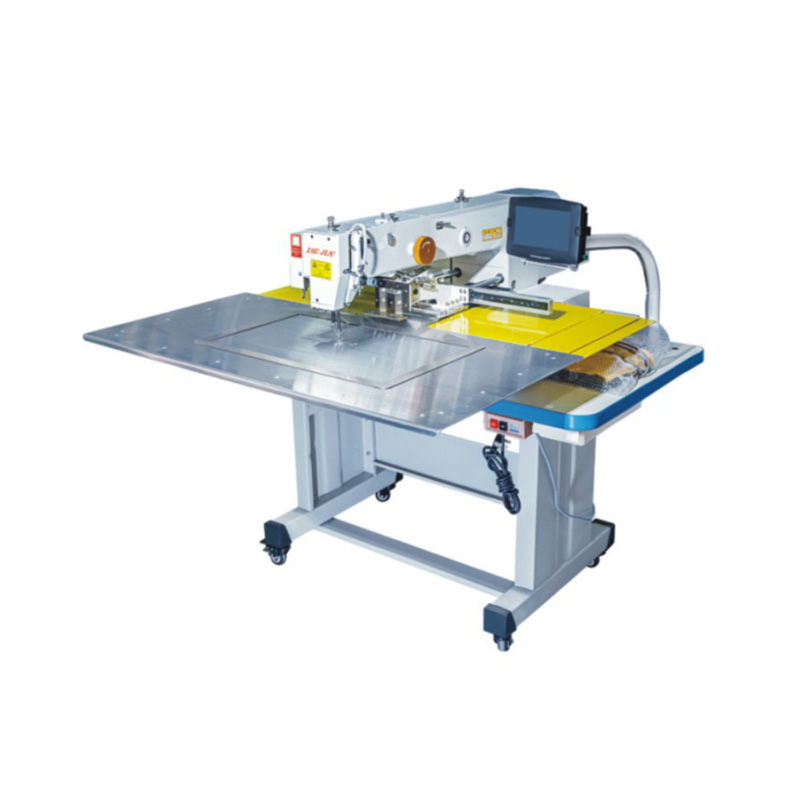
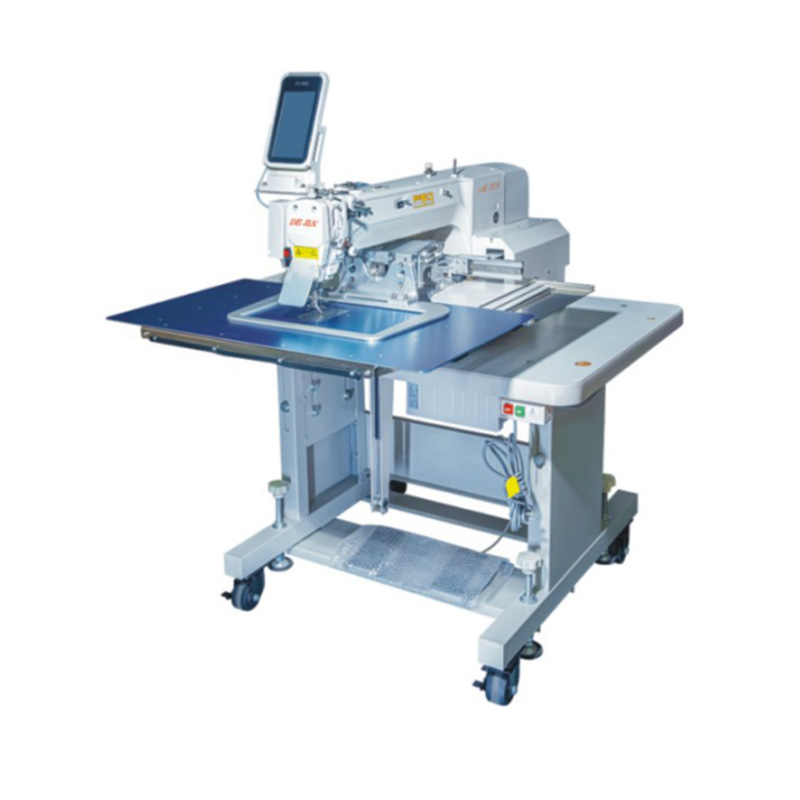
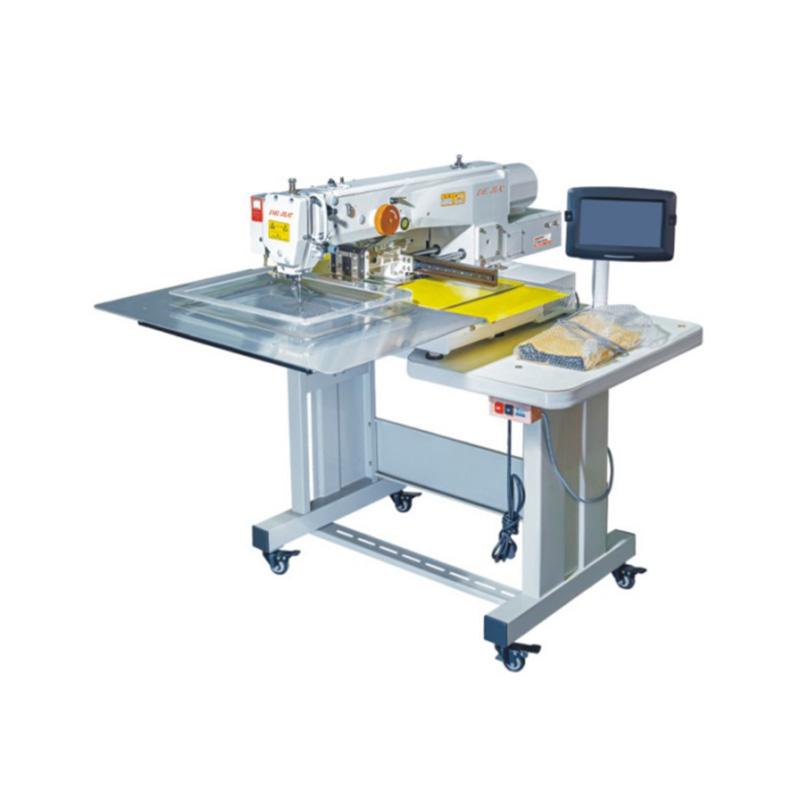
Pattern sewing machines, also known in the industry as computerized pattern sewing machines or numerical control pattern sewing machines, are industrial-grade automated sewing equipment whose sewing trajectory is controlled by a computer program. Unlike traditional sewing machines, which require operators to manually push the fabric and control the stitching based on experience, pattern sewing machines fix the fabric to a special jig/clamp. X-Y axis stepper motors drive the fabric frame to move precisely, while the main spindle motor controls the needle bar's up-and-down movement. Both work together to complete any preset geometric pattern.
Simply put: You import your designed pattern (such as a brand logo, pocket shape, or reinforced frame lines) into the machine, and it can repeat that pattern an unlimited number of times with zero deviation—whether it's the first piece or the 10,000th, the stitch positions are completely consistent.
Application Scenarios of Pattern sewing machines
1. Apparel and Accessories
- Jeans Pockets: The fully automatic pocket patch unit can sew round, square, curved, and asymmetrical pocket openings. One machine can replace the daily output of seven traditional operators, and no skilled technicians are required.
- Trademarks and Labels: Small pattern sewing machines precisely sew brand woven labels, care labels, and size labels. Over 999 patterns can be stored and retrieved when changing styles.
- Bar Tacking: Sewing Box-X or grid-shaped reinforcement frames at stress points on backpack shoulder straps, harnesses, and climbing ropes to ensure no tearing in load-bearing areas.
- Military/Workwear: Precise positioning and sewing of arm patches, badges, and functional patch pockets.
2. Handbags, Luggage, and Leather Goods
- Handbag Panel Sewing: Sewing multiple leather/PU panels according to preset patterns, ensuring consistent stitch spacing and corner curvature for each batch.
- Luggage/Backpack Reinforcement: Sewing complex reinforcement patterns at handles, zippers, and shoulder strap connections. Heavy-duty machines with thick thread can handle 5mm thick multi-layer composite materials.
- Wallets/Belts: Batch replication of decorative stitching. CNC scaling allows proportional adjustment of the same pattern for different sized products.
3. Automotive Interiors and Aviation Seats
- Automotive Seat Covers: Large pattern sewing machines (2000mm x 900mm working area) can complete the pattern sewing of the entire seat panel in one go, including seam lines, decorative lines, and reinforcement lines.
- Door Panel Covers/Dashboards: Precise positioning and sewing of three-dimensional fabric pieces, using specialized clamps to ensure that multiple layers of material do not shift.
- Yacht/Aviation Seats: Complex pattern sewing of high-end interiors, requiring extremely high stitch consistency, which cannot be achieved manually.
4. Furniture Upholstery
- Sofas/Mattresses: Extra-large working area (2500mm x 900mm) can process the entire sofa panel, completing multiple processes such as splicing, edging, and decorative lines.
- Office Chairs/Dining Chairs: Structural sewing and exterior decoration of seat cushions and backrests.
5. Industrial Safety and Lifting
- FIBC (Flexible Intermediate Bulk Container) Bags: Dedicated machines (600mm x 500mm working area) sew reinforced lifting rings and bottom patches at speeds up to 2,000 stitches/minute, using thick thread to ensure safe load-bearing capacity up to 2 tons.
- Lifting Slings/Safety Harnesses: Heavy-duty machines can sew 14mm thick high-density synthetic fiber webbing using V415 (Metric #7) extra-thick thread, with a 6x high-capacity rotary hook to reduce the frequency of thread changes.
- Climbing Ropes/Safety Ropes/Parachutes: Reinforcing eye splices are sewn at the rope ends, requiring absolutely uniform stitches; any deviation could lead to a safety accident.
6. Outdoor and Nautical
- Sailing Sails: Large, long-arm machines handle the splicing and reinforcement of Dacron/Kevlar canvas, with precise pattern control to optimize sail aerodynamics.
- Tents/Tannels: Seam stitching for oversized fabrics; CNC systems ensure straightness of long-distance stitches.
- Hot Air Balloons/Gliders: Aerospace-grade applications requiring extremely high stitching precision.
7. Floral Decorations and Creative Sewing
- Women's Wear/Scarves/Handkerchiefs: CNC pattern sewing machines can sew intricate floral patterns, geometric textures, and wavy decorative lines, transforming traditional hand embroidery into industrialized mass production.
- Swimwear/Sportswear: Decorative pattern sewing on elastic fabrics; electronic tension control ensures consistent tension across different thicknesses.
- Home Textiles/Curtains: Decorative stitching on cushions, tablecloths, and bed runners, enhancing product added value.
Reasons for Purchasing: Why Buy?
1. Efficiency Leap: One Machine Replaces Multiple Skilled Workers
According to industry measurements, the efficiency of one standard pattern sewing machine in sewing handbag labels or reinforced frames is equivalent to the daily output of seven traditional sewing machine operators. For labor-intensive manufacturing industries facing recruitment difficulties, this means directly reducing labor costs and simultaneously addressing the pain point of "skilled worker attrition."
2. Zero Skill Dependency: New Employees Can Start Working on the Same Day
The pattern-making machine transforms "sewing technology" into "program data." Operators only need to load and unload fixtures and press the start button. No 3-5 years of sewing apprenticeship is required; new employees can operate independently after half a day of training. This is especially crucial for factories with large seasonal order fluctuations and high demand for temporary workers.
3. Unlimited Pattern Expansion: From Structural Stitching to Brand Decoration
One machine can store over 10,000 patterns and supports:
- Scaling: Independent X/Y axis adjustment from 10% to 400%, adapting the same pattern to different product sizes
- Rotation: 360° rotation at any angle, no reprogramming required
- Mirroring: Horizontal flipping, quickly generating symmetrical patterns
- USB Import/Export: The design department draws patterns on the computer, imports them to the machine via USB drive for production
This means you can use the same machine to create structural reinforcement frames in the morning, brand logo decorations in the afternoon, and customized floral patterns for clients in the evening—big equipment utilization.
4. Automation Reduces Auxiliary Labor Time
Modern pattern sewing machines are equipped with:
- Automatic Thread Trimmer: Eliminates manual thread trimming, saving 3-5 seconds per process
- Automatic Presser Foot Lift: Reduces operator bending
- Automatic Back Tacking: Ensures secure start and end points
- Thread Breakage Detector: Automatically stops the machine and alarms upon thread breakage, preventing batch defects
- Bobbin Thread Detector: Automatically stops the machine when bobbin thread runs out, preventing empty stitches
It is estimated that these functions can save 4-5 hours of auxiliary labor time per machine per day, directly reducing reliance on manual labor in a market environment with a shortage of skilled workers.
5. Servo Direct Drive: Energy Saving, Quiet, Precise
Utilizing a 550W-750W integrated servo motor to directly drive the spindle, compared to traditional clutch motors:
- Energy saving 70%-90%
- Significantly reduced operating noise
- Low speed, high torque: Even at needle speeds reduced to 200rpm, it maintains strong penetration power, suitable for starting stitches on thick materials
- Needle position positioning: Precisely controls the needle stop position (upper/lower), facilitating cornering and fabric repositioning
Frequently Asked Questions
Q1: What is the difference between a pattern sewing machine and a regular computerized flatbed sewing machine?
A: A regular computerized flatbed sewing machine can only sew straight lines; the operator still needs to manually push the fabric to control the direction. A pattern sewing machine automatically drives the fabric movement through an X-Y axis CNC system, capable of sewing arbitrary curves, geometric shapes, and complex patterns. Simply put: a flatbed sewing machine is a "straight-line machine with a brain," while a pattern sewing machine is a "drawing machine with a brain."
Q2: Is pattern programming complex? Is a dedicated programmer required?
A: Modern models can be graphically programmed via a 7-inch touchscreen, allowing users to define sewing paths by dragging and dropping with their fingers, much like sketching. Complex patterns can also be drawn on a computer using the accompanying software and imported via USB drive. No professional CNC programmer is required; workshop technicians can operate the machine independently after 1-2 days of training.
Q3: Is the thread breakage detection function really necessary?
A: Absolutely. When sewing thick threads (such as V277 and V415) at high speeds, the thread tension is high, and frictional heat is high, significantly increasing the probability of thread breakage. Thread breakage detection automatically stops the machine and sounds an alarm the moment a thread breaks, allowing the operator to simply re-thread the machine and resume sewing from the break point. Without this function, the machine would continue sewing without thread, potentially rendering the entire batch of products unusable—for high-value materials (such as Kevlar and leather) or safety products, the loss prevention value of this function far outweighs its cost.


 Español
 عربى
عربى