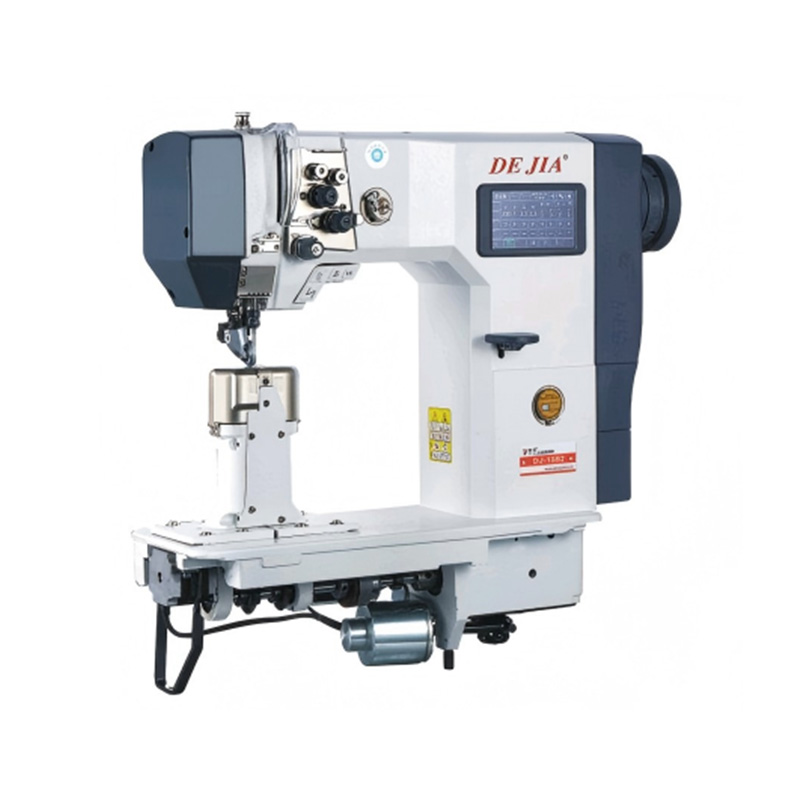
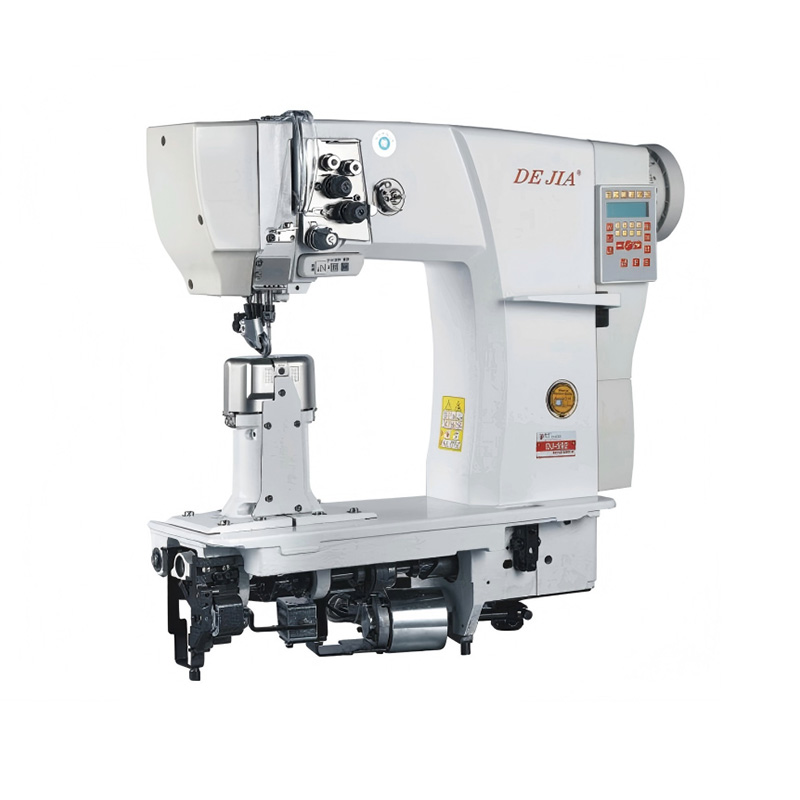
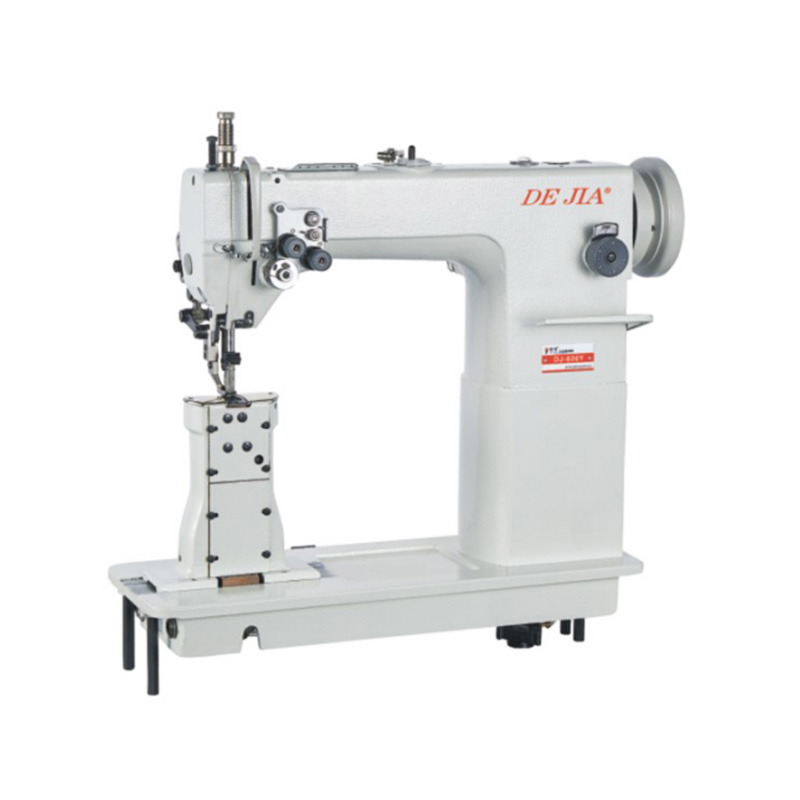
A double-needle industrial sewing machine is an industrial-grade sewing device equipped with two parallel needle bars. It completes two parallel stitches simultaneously in a single operation, achieving highly efficient "double stitching" (one needle, two seams). Compared to a single-needle machine, it essentially combines two independent sewing processes into one, significantly shortening the production cycle.
Based on needle bar structure, it can be divided into two main types:
- Fixed Needle Bar: The two needle bars are rigidly linked, with a fixed stitch length that cannot be adjusted. Suitable for standardized, high-volume production, such as straight-line sewing of shirts and trousers, with a big sewing speed of 3,000-4,000 stitches per minute.
- Split Needle Bar: The two needle bars move independently, allowing individual control of the start and stop of one stitch. This enables complex processes such as corner sewing and curved stitching, suitable for decorative sewing and irregularly shaped sewing.
Based on machine form, they are further subdivided into:
- Flat-Bed: Suitable for flat fabrics such as shirts, jeans, and uniforms.
- Post-Bed: Suitable for three-dimensional parts such as bags, shoes, and automotive interiors.
- Cylinder-Bed: Designed specifically for cylindrical workpieces such as cuffs, trouser legs, and filter bags.
- Long-Arm: Working space of over 850mm, suitable for large-sized materials such as tents, tarpaulins, and sails.
Application Scenarios of double-needle industrial sewing machine
1. Apparel Manufacturing
- Jeans: Back pocket patch pockets, waistband stitching, decorative topstitching. Some specialized models (such as jeans pocket machines) can complete approximately 1,300 pairs of pockets in 8 hours and support two-color thread decoration.
- Shirts/Uniforms: Parallel topstitching on plackets, cuffs, and hems. Fixed needle bar models ensure consistent stitch spacing, meeting the needs of batch standardization.
- Sportswear/Casual Wear: Reinforced stitching of elastic fabrics. Double-needle structure enhances seam strength, suitable for high-intensity sports scenarios.
2. Automotive Interiors and Aviation Seats
- Leather upholstery for automotive seats, door panel stitching; separate needle bar machines can handle corners and curves.
- Naval Interiors: Thick material stitching for yacht seats, using composite feeding (needle feed + dog feed + alternating presser feet) to prevent misalignment of multiple layers of leather.
3. Leather and Bags
- Double-stitched decorative stitching for belts, wallets, and handbags.
- Reinforced seams for suitcases and backpacks; large rotary hook machines can handle thick thread (#46 to #210), improving the durability of load-bearing parts.
4. Outdoor and Industrial Products
- Tents/Tantarpaulins/Sails: Long-arm double-needle machines can handle oversized fabrics; double-row stitching enhances waterproof sealing.
- Filter Bag Manufacturing: Cylindrical double-needle machines are used for longitudinal stitching of industrial dust collector filter bags; synchronous feeding ensures thick filter material does not shift.
- Reflective Vests/Safety Clothing: Dedicated models are equipped with a 46mm large stitch length device and webbing guide, enabling one-time completion of reflective strip application and decorative stitching.
5. Furniture Upholstery
- Upholstery stitching for sofas and mattresses; column-type models are suitable for three-dimensional edging operations.
Reasons for Purchase: Why Buy?
1. Doubled Efficiency, Direct Cost Reduction
Double-needle machines complete two stitches in one pass, reducing process time by approximately 40%-50% compared to single-needle machines which require two passes. For example, a dedicated double-needle machine can produce over 1,300 pairs of stitches per day for jeans pockets, directly reducing labor costs per piece.
2. Consistent Stitch Length, Stable Quality
Fixed-needle bar models ensure an absolutely constant distance between the two needles through a rigid structure, avoiding deviations caused by manual double-pass stitching. For decorative stitching on branded apparel, parallelism and equidistant spacing are core quality indicators.
3. Dual-purpose, flexible switching
Separate needle bar models support "dual-needle/single-needle" mode switching—use dual needles for daily use to improve efficiency, and when encountering complex corners or single-needle requirements, one needle can be deactivated without replacing the entire machine, reducing equipment investment costs.
4. Adaptable to thick materials and coarse threads
Industrial dual-needle machines are generally equipped with large-capacity rotary hooks and large-hole needle plates, capable of handling multi-layer materials (such as denim + lining + leather) with thicknesses of 5mm-17mm, adapting to coarse thread sewing and meeting the needs of heavy-duty applications.
5. Automation reduces reliance on manual labor
Modern models generally integrate:
- Automatic thread trimming (reduces thread end handling time)
- Automatic backstitch reinforcement (improves seam strength)
- Automatic presser foot lifting (reduces operator fatigue)
- Servo motor + needle position positioning (precise start/stop, reduces scrap rate).
It is estimated that automation functions can save 4-5 hours of auxiliary labor per machine per day.
6. Durability and Low Maintenance
The industrial-grade body (typically a 40-90kg metal structure) with an automatic lubrication system supports 24/7 continuous operation. Core components (hairpin, feeding mechanism) are designed for a lifespan exceeding 10 years, suitable for high-intensity production environments.
Frequently Asked Questions
Q1: How to choose between a fixed needle bar and a separate needle bar?
A: If your orders primarily involve standardized straight stitching (e.g., shirt plackets, jeans waistbands), choose a fixed needle bar—it's faster and more affordable. If it involves corners, curves, or decorative sewing (e.g., car seats, 3D stitching for bags), choose a separate needle bar—it offers greater flexibility and can handle complex processes.
Q2: Can the stitch length of a double-needle sewing machine be adjusted?
A: The stitch length of a fixed needle bar is not adjustable after factory setting (common specifications: 1/4 inch, 3/8 inch, 6.4mm, 7.9mm, etc.). Please confirm your product's process requirements before purchasing. The stitch length of a separate needle bar is adjustable on some models, but the adjustment range is limited. It is recommended to select the specification based on your main product line.
Q3: What's the difference between a servo motor and a clutch motor?
A: Servo motors are currently the mainstream configuration. Compared to traditional clutch motors, they offer quieter operation, save approximately 70%-90% on electricity, are one-third lighter, have controllable speed (suitable for beginners), and eliminate the need to replace easily worn parts like carbon brushes, resulting in lower long-term maintenance costs.
Q4: What thickness of material can a double-needle sewing machine sew?
A: It depends on the model. Standard flatbed double-needle sewing machines typically handle thicknesses up to 5mm; heavy-duty column/long-arm models can handle 10mm-17mm (e.g., multi-layered canvas + leather). When purchasing, be sure to confirm the "big sewing thickness" parameter and actually measure your thickest material combination.
Q5: Are double-needle machines much more expensive than single-needle machines?
A: Double-needle machines are approximately 1.3-1.8 times more expensive than comparable single-needle machines. However, considering the savings on a process, a machine, and a workstation, the return on investment period is typically 6-12 months. For factories with a monthly output exceeding 5,000 pieces, the economic advantages of double-needle machines are very significant.


 Español
 عربى
عربى