

 Español
 عربى
عربىProduction floor layout rarely gets discussed outside manufacturing circles, yet the placement of an industrial flat bed sewing machine within a garment or textile facility says a lot about what kind of product moves through that line every day. Flat bed configurations dominate certain production categories precisely because the flat working surface accommodates specific fabric handling needs that other bed styles cannot match.
Apparel Assembly Lines
Standard garment factories rely on an industrial flat bed sewing machine for the bulk of straight-seam construction work, including side seams, hemming, and panel joining across shirts, trousers, and dresses. Which seam types depend most heavily on this bed configuration? Long straight seams running the full length of a garment panel benefit from the unobstructed flat surface, since fabric feeds smoothly across the bed without the tube-shaped obstruction that a cylinder or post bed design would introduce. Operators working high-volume apparel lines typically run multiple flat bed stations in sequence, each handling a specific seam type as a garment panel moves down the assembly chain.
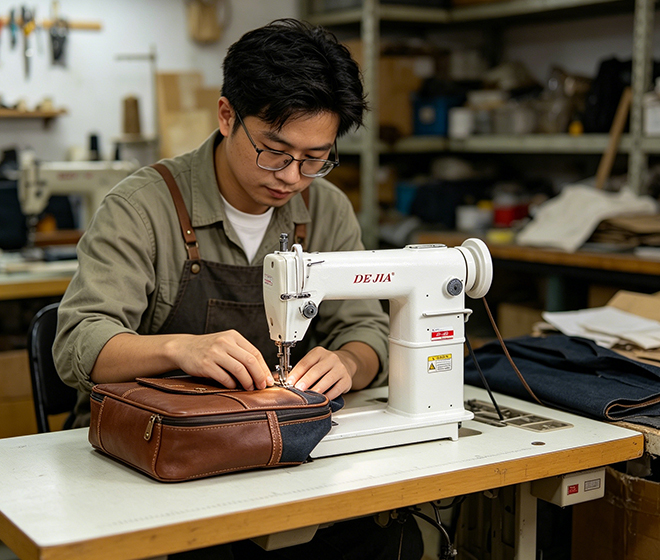
Where does this configuration fall short compared to other bed types? Curved or tubular sections, such as sleeve cuffs or collar bands, are harder to maneuver on a flat surface, which is why many apparel lines pair flat bed stations with cylinder bed machines positioned specifically for those tubular assembly steps.
Home Textile And Bedding Production
Bedding manufacturers, including facilities producing sheets, pillowcases, and duvet covers, depend on an industrial flat bed sewing machine for wide panel seaming across large fabric widths. Home textile production often involves considerably wider seam runs than standard garment work, and the flat bed's open surface accommodates this width without requiring fabric to bunch or fold awkwardly during the sewing pass. A flat bed sewing machine fitted with an extended table surface handles these wider panels more comfortably than a standard-size table designed primarily for garment-scale fabric pieces.
Upholstery And Furniture Cover Manufacturing
Upholstery workshops producing furniture covers, cushion casings, and seat panels use flat bed configurations for the flat panel sections that make up the bulk of most upholstery pieces. Which specific upholstery components rely most on this bed style? Cushion top and bottom panels, along with straight-edge side panels before they get joined into a finished cushion shape, since these components consist of flat fabric sections joined along straight or gently curved seam lines that a flat working surface handles efficiently.
Bag And Luggage Component Assembly
Bag manufacturing facilities, particularly those producing tote bags, backpack panels, and luggage lining, rely on an industrial flat bed sewing machine for joining flat fabric panels before more complex three-dimensional assembly happens further down the production line. Do bag manufacturers use flat bed machines for the entire construction process? Typically not for the full assembly, since bag construction eventually requires joining panels into a three-dimensional shape that benefits from a different bed configuration, but the initial flat panel work, including pocket attachment and lining seams, runs efficiently on flat bed equipment before the piece moves toward final shaping.
Technical And Industrial Fabric Applications
Beyond consumer goods, technical fabric producers manufacturing items like tarpaulins, tent panels, and industrial covers use heavy-duty flat bed configurations built to handle thicker, more rigid material than standard apparel fabric. A flat bed sewing machine specified for this application typically includes a reinforced feed mechanism and a stronger motor than a standard garment-line unit, since technical fabrics resist feeding through the machine with the same ease as lighter woven textiles. Which factor most influences equipment selection for this application? Fabric thickness and stiffness drive most specification decisions, since technical fabric producers need feed mechanisms capable of pulling heavier material through the machine consistently without slippage or uneven stitch spacing across a long production run.
