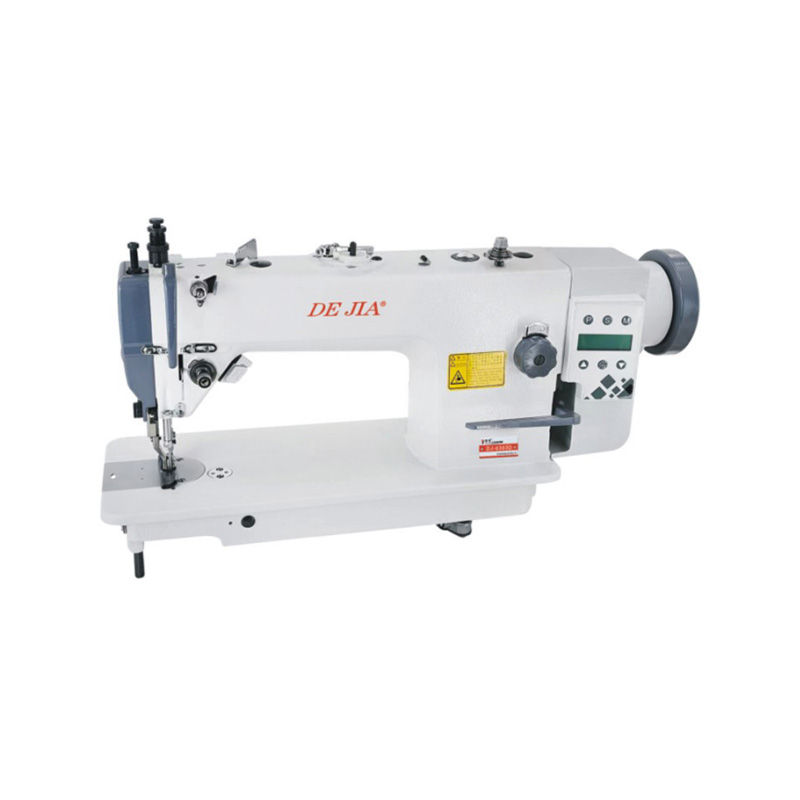
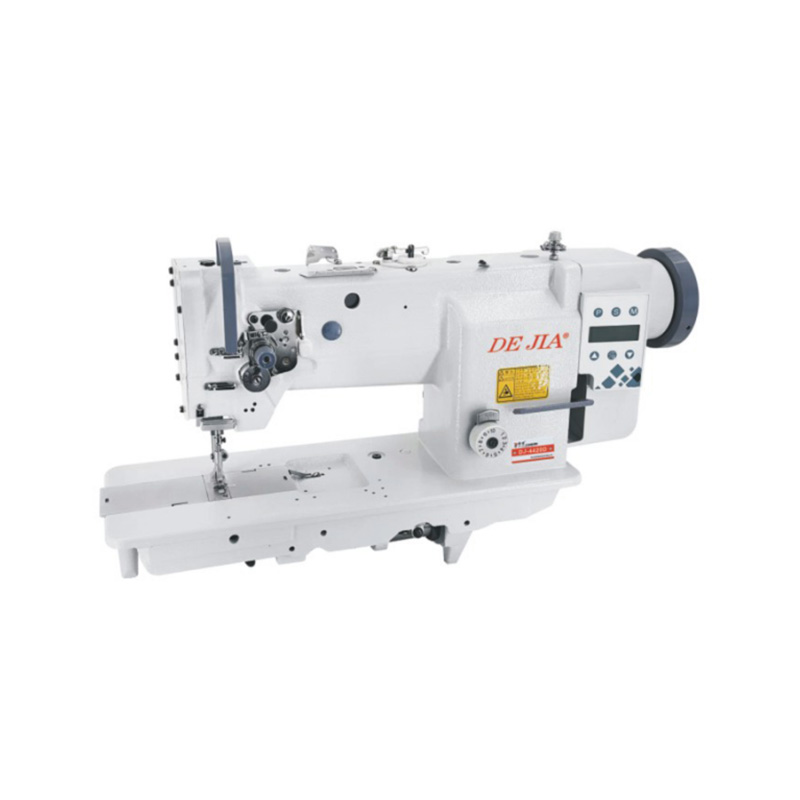
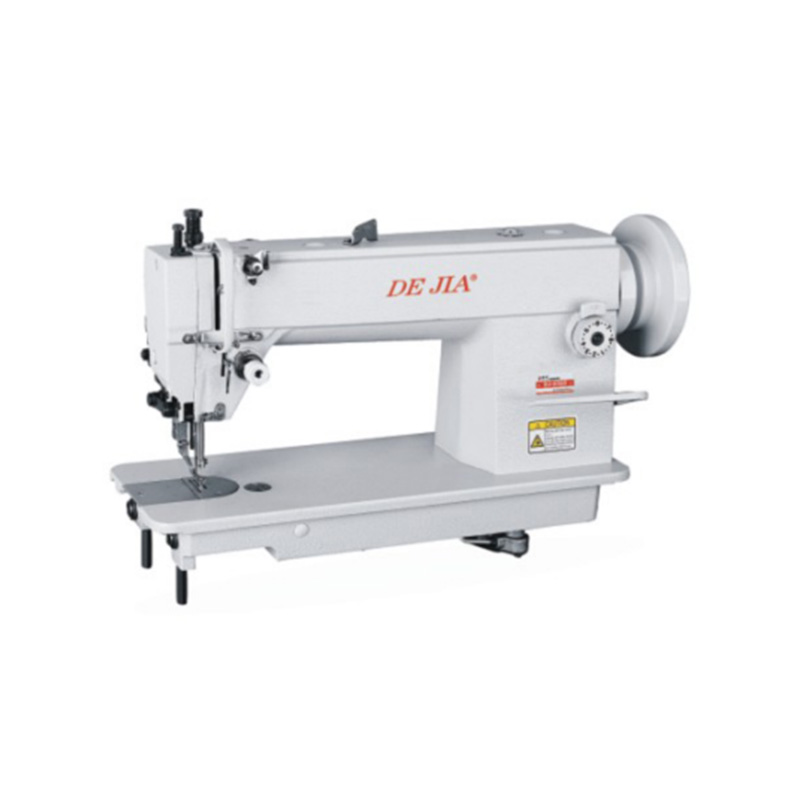
Industrial flatbed sewing machines, with their horizontally extended table providing big support area, are core equipment for mass production of flat fabrics in garments, home textiles, and workwear.
What is a Flatbed Sewing Machine?
A flatbed sewing machine is an industrial sewing machine where the sewing head and table are on the same horizontal plane. It is the more basic and widespread type of industrial sewing machine. Its wide, flat table allows the fabric to move freely around the sewing head, enabling the operator to easily align the stitches and control the direction. It is ideal for straight or slightly curved sewing of large-format fabrics.
The frame of an industrial flatbed sewing machine is made of cast iron or high-strength cast aluminum, equipped with a 400–750 W servo motor, achieving speeds of 3,000–6,000 SPM (depending on the model and feeding method). The feeding system is a core parameter differentiating machine performance—from the more basic drop feed to synchronous/compound feed, different methods adapt to different material thicknesses and precision requirements.
Feeding Method: A Core Dimension for Flatbed Laundry Machine Selection
The feeding method determines the material compatibility range of the flatbed laundry machine and is the more crucial parameter to clarify during B2B procurement.
Only the lower teeth push the fabric forward. Simple structure, high speed, suitable for uniform thin materials. Layer misalignment is common.
The upper presser foot and lower teeth advance synchronously (Synchronous Feed), with upper and lower layers moving simultaneously to prevent layer misalignment. Suitable for medium-thickness, multi-layer sewing.
The needle bar participates in the feeding action. Suitable for processes requiring high-precision feeding, such as checkered pattern alignment and fine striped fabrics.
The needle bar, presser foot, and lower teeth work together (Compound Feed). Strongest anti-misalignment capability, suitable for difficult-to-seam materials such as leather and multi-layered canvas.
Selection Tips: Synchronous feeding platform sewing machines are currently the more widely purchased type of machine in factories. They balance speed and interlayer accuracy, are suitable for more industrial fabrics with a thickness of 60–300 g/m², and are standard equipment on mass production lines for workwear, uniforms, and school uniforms.
Application Scenarios of Platform Sewing Machines
- Match Production of Garments
The main sewing processes for T-shirts, shirts, trousers, and jackets are completed on platform sewing machines. The flat table allows operators to quickly lay out materials and align seams, making it suitable for collaborative workflows and a mainstay model in garment factories.
Safety vests, fire-resistant clothing, factory uniforms, and other garments requiring the sewing of multiple layers of thick materials while maintaining a smooth appearance. Synchronous feeding platform sewing machines prevent misalignment between layers of thick fabric and are suitable for workwear fabrics with a thickness of 300 g/m² or higher.
- Home Textiles and Bedding
Large-format home textile products such as sheets, duvet covers, curtains, and pillowcases rely on the wide tabletop of a platform lathe to support the weight of the fabric and prevent seams from warping due to fabric sagging. An extended auxiliary tabletop is typically used in conjunction with this machine.
- Bags and Luggage Flat Panels
Sewing flat pieces such as handbag outer panels, backpack panels, and luggage fabrics utilizes heavy-duty industrial platform lathes or triple-feed lathes, capable of handling thicker fabrics such as PU leather, Oxford cloth, and 1000D nylon.
- Industrial Packaging and Logistics Bags
Industrial packaging products such as FIBCs (Flexible Intermediate Bulk Containers), woven bags, and canvas storage bags require heavy-duty platform lathes. The stitches must withstand weight, typically using Tex 135 or thicker thread and a larger bobbin.
- Outdoor Equipment and Tents
Waterproof coated fabrics such as tent fabric, sleeping bag outer layers, and awnings require a large tabletop for support and synchronous feeding to prevent scratches on the coated surface. Some processes also require the use of Teflon presser feet.
Reasons for Procurement?
- More Mature Industrial Sewing Machine with a Complete Supply Chain
Platform sewing machines are the oldest and high-volume industrial sewing machine type globally. Their parts (hook, presser foot, feed dog, needle plate) have a high degree of global standardization, facilitating local spare parts procurement and small downtime for maintenance. This makes them the preferred choice for factories to reduce the risk of unplanned downtime.
- Synchronous Feeding System Directly Reduces Scrap Rate
Traditional bottom-feed sewing machines suffer from inconsistent feed speeds between upper and lower layers when sewing multi-layered thick fabrics, leading to seam misalignment and wrinkling, resulting in a significantly higher scrap rate than synchronous feeding machines. Upgrading to a synchronous feeding platform sewing machine typically controls the interlayer error of multi-layered sewing to within 1 mm, which is particularly crucial for high-precision products such as tooling and safety equipment.
- Quantifiable Energy Savings from Servo Motors
Compared to older clutch motors, platform sewing machines using servo motors consume 30%–50% less electricity under the same production volume conditions. For factories with 50 or more sewing machines, the electricity savings from servo system upgrades can typically recoup the equipment cost difference within 18–36 months.
- Computerized models accelerate changeover response
Computerized platform sewing machines equipped with digital control panels support quick recall and storage of sewing parameters (stitch length, backstitch count, stop position). Operators do not need to manually adjust the machine during changeovers, significantly improving changeover efficiency for factories with multiple SKUs and small batch orders.
- Highly expandable worktable, adaptable to auxiliary equipment
Platform sewing machines have a highly standardized worktable, allowing for easy installation of auxiliary equipment such as automatic feeding devices, template clamps, and photoelectric pattern matching sensors. This provides a foundational platform for factories to implement semi-automation upgrades, with expansion costs far lower than purchasing entirely new dedicated automatic machines.
Frequently Asked Questions
How much difference is there between synchronous feeding and ordinary bottom-feed platform sewing machines in actual production?
When sewing single-layer thin fabrics (such as 100 g/m² cotton fabric for shirts), the difference is not significant. However, when the number of sewing layers exceeds three, or the fabric weight exceeds 200 g/m², the upper layer of fabric on the bottom feeder will lag due to friction, resulting in significant interlayer misalignment (commonly known as "material creep"). The synchronous feeder's upper presser foot and lower teeth move synchronously, propelling the upper and lower layers of fabric at the same speed, fundamentally eliminating the material creep problem. For thicker fabrics such as workwear, denim, and workwear, this difference directly translates to higher scrap and rework rates.
Industrial platform sewing machines and home sewing machines have similar appearances. Can a home sewing machine replace an industrial one in production?
No. The core difference lies in the duty cycle: home sewing machines are designed for intermittent use, with motors typically supporting only a few minutes of continuous operation per cycle; industrial platform sewing machines are designed to support 8–16 hours of continuous operation, and their frames are made of cast iron or heavy-duty cast aluminum to absorb vibration. Home-use rotary hook machines are prone to motor damage due to overheating in continuous production environments. Furthermore, their small bobbin capacity (requiring frequent downtime for thread changes) and significantly lower stitch tension stability compared to industrial models fail to meet the consistent quality requirements of commercial orders.
When purchasing rotary hook machines in bulk, how do you assess a supplier's spare parts availability?
Focus on verifying the following three points:
- Is the rotary hook model a universal standard type (e.g., DB/M series)? Universal models can be quickly procured globally, while proprietary models face a high risk of supply disruption.
- Can the supplier commit to local inventory or delivery within 5 business days for frequently worn parts (feed dogs, needle plates, presser feet)?
- Has the machine model been on the market for more than 3 years? Sufficient market presence indicates a more mature after-sales network and lower downtime maintenance costs.


 Español
 عربى
عربى